2. Dhanushkodi, Tamil Nadu
At the southeastern edge of Pamban Island, near Rameswaram, lies Dhanushkodi.
Its setting alone makes it extraordinary.
The narrow landscape stretches towards the sea, with the Bay of Bengal and Indian Ocean meeting around this remote part of Tamil Nadu.
But Dhanushkodi has a tragic history.
The town was devastated by the powerful 1964 Rameswaram cyclone, after which much of the settlement was left destroyed.
Remains associated with the old town can still be seen around the area, creating a striking contrast between ruined structures and the surrounding coastline.
Dhanushkodi is therefore different from a supposedly haunted village. Its abandoned character is tied to a documented natural disaster.
How to Reach Dhanushkodi
Most travelers first reach Rameswaram.
From there, Dhanushkodi can be explored as a road trip towards the eastern end of the island.
A simple itinerary is
Rameswaram → Dhanushkodi → Arichal Munai → Rameswaram
The journey itself is one of the highlights because the road passes through an increasingly isolated coastal landscape.
3. Netaji Subhas Chandra Bose Island, Andaman & Nicobar Islands
Just off Sri Vijaya Puram, formerly known as Port Blair, is an island filled with remnants of the British colonial period.
Known historically as Ross Island, it is now officially called Netaji Subhas Chandra Bose Island.
During British rule, the island served as an important administrative and social center.
Today, visitors can see the remains of colonial buildings gradually being overtaken by tropical vegetation.
Old structures, pathways, and ruins create the feeling of walking through a settlement that nature is slowly reclaiming.
Unlike Kuldhara or Dhanushkodi, reaching this abandoned settlement requires travelling by water rather than simply driving there.
How to Reach
Travelers first need to reach Sri Vijaya Puram in the Andaman Islands.
Boat services connect the city with Netaji Subhas Chandra Bose Island.
The island can generally be explored as part of a short excursion and is often combined with other historical and coastal attractions around Sri Vijaya Puram.
4. Lakhpat, Gujarat
Close to the western edge of Gujarat’s Kutch region lies Lakhpat, a historic fortified settlement with a dramatically different atmosphere from India’s crowded cities.
Lakhpat was once associated with important trade activity in the Kutch region.
Changing geographical and economic conditions eventually reduced its importance, and its population declined significantly.
What makes Lakhpat particularly interesting is its large fort wall surrounding a settlement that feels remarkably quiet compared with the scale of its historic defenses.
Visitors can explore old structures, religious sites, and views across the surrounding landscape.
Lakhpat is not completely abandoned today, so technically it differs from a true ghost town. However, its sparse population and historic decline have frequently earned it a place in discussions about India’s forgotten settlements.
How to Reach Lakhpat
Bhuj is one of the most practical starting points for exploring western Kutch.
Because Lakhpat is relatively remote, road travel is important when planning a visit.
Travellers can combine it with other destinations in Kutch instead of making the long journey only for one attraction.
5. Kuldhara’s Lesser-Known Neighbour: Khabha, Rajasthan
Kuldhara receives most of the attention, but it was not the only settlement in the Jaisalmer region associated with the migration of Paliwal communities.
Khabha is another abandoned settlement southwest of Jaisalmer.
Its ruins provide a glimpse into the architecture and settlement patterns of the region without the same level of fame as Kuldhara.
For travelers interested in archaeology, desert history, and unusual destinations, Khabha can be an interesting addition to a Jaisalmer trip.
Why Visit?
The attraction here is not a dramatic ghost story.
It is the opportunity to stand among the remains of a community that once adapted to one of India’s harshest landscapes.
Khabha also works well for travellers who want to explore beyond Jaisalmer’s most popular tourist circuit.
6. Bhangarh, Rajasthan
Bhangarh is frequently described as one of India’s most haunted places.
But behind the supernatural stories is something equally interesting: the remains of a historic settlement.
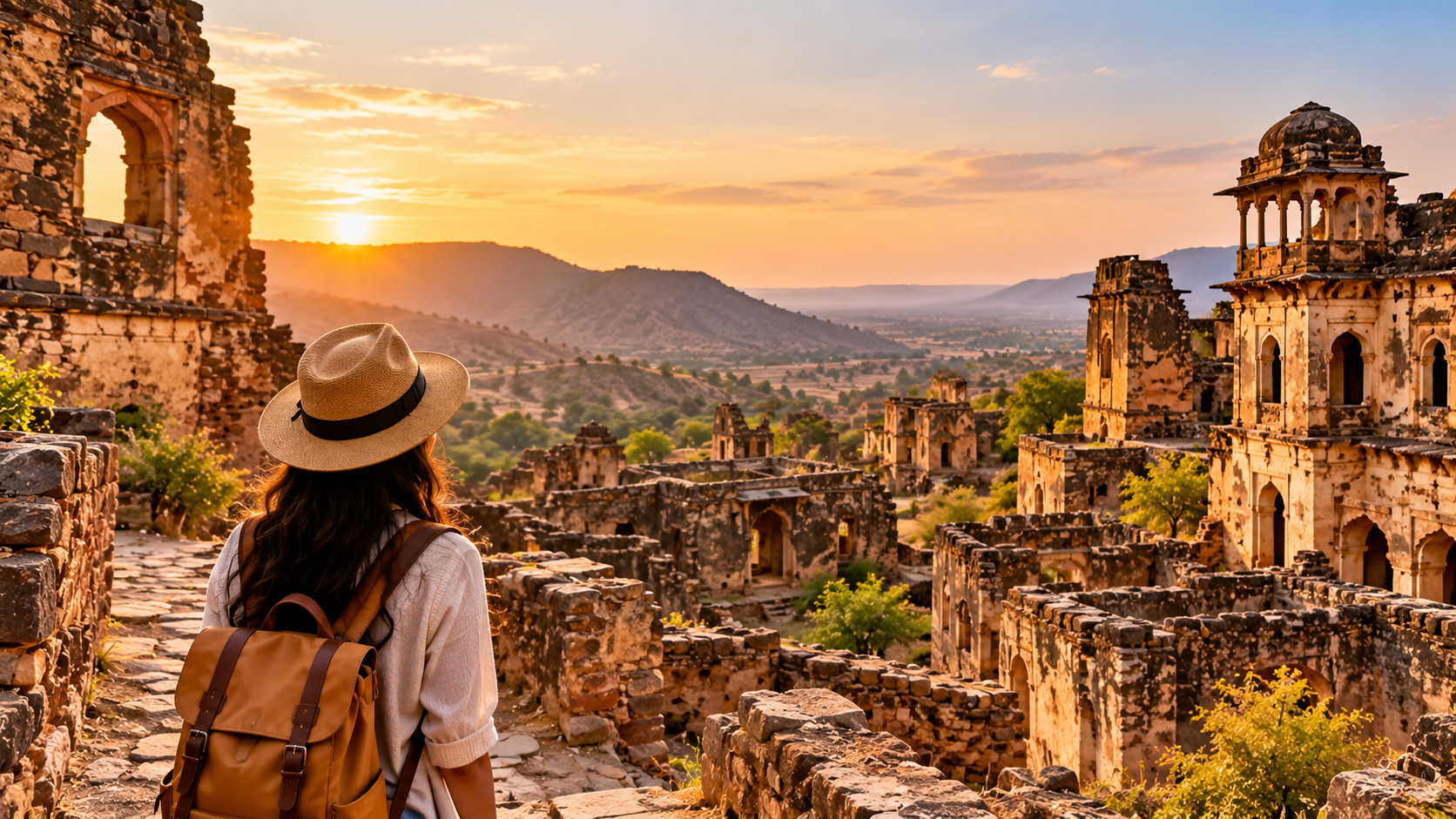
Located in Rajasthan’s Alwar district, the Bhangarh complex contains ruined houses, temples, marketplaces, and palace structures.
Various legends attempt to explain its decline, and these stories have helped make Bhangarh famous among travellers.
However, visitors do not need to believe the paranormal stories to find the destination fascinating.
Walking through the abandoned market areas and historic structures provides a glimpse into what was once a functioning settlement.
How to Reach Bhangarh
Bhangarh can be reached by road and is often approached from Jaipur, Alwar, or the Delhi NCR region.
Because of its Rajasthan location, it can also be combined with other heritage destinations rather than visited as an isolated attraction.
Visitors should follow the official entry timings and local restrictions instead of attempting to enter restricted areas after permitted visiting hours.
7. An Abandoned Side of India’s Industrial History
Not every Indian ghost town is centuries old.
Across the country there are also settlements that declined because mines closed, industries moved, or employment disappeared.
These places tell a more modern story of abandonment.
Unlike famous tourist attractions such as Kuldhara and Dhanushkodi, many former industrial settlements have limited tourism infrastructure and may include private or unsafe property.
That means travelers should not enter abandoned mines, factories, or restricted buildings simply because a location appears deserted.
Exploring India’s forgotten places should always involve respecting local restrictions, private property, and safety instructions.