Car Ownership vs Car Rental is one of the most common financial decisions people face when planning their transportation needs. For many Indians, owning a car is a dream and a symbol of convenience. The idea of having your own vehicle parked outside your home feels rewarding because it offers freedom, comfort, and flexibility for daily travel.
On the other hand, many travelers and businesses are now choosing professional transportation solutions instead of purchasing a vehicle. A reliable car rental service in India provides flexibility, convenience, and cost control without the financial burden of ownership.
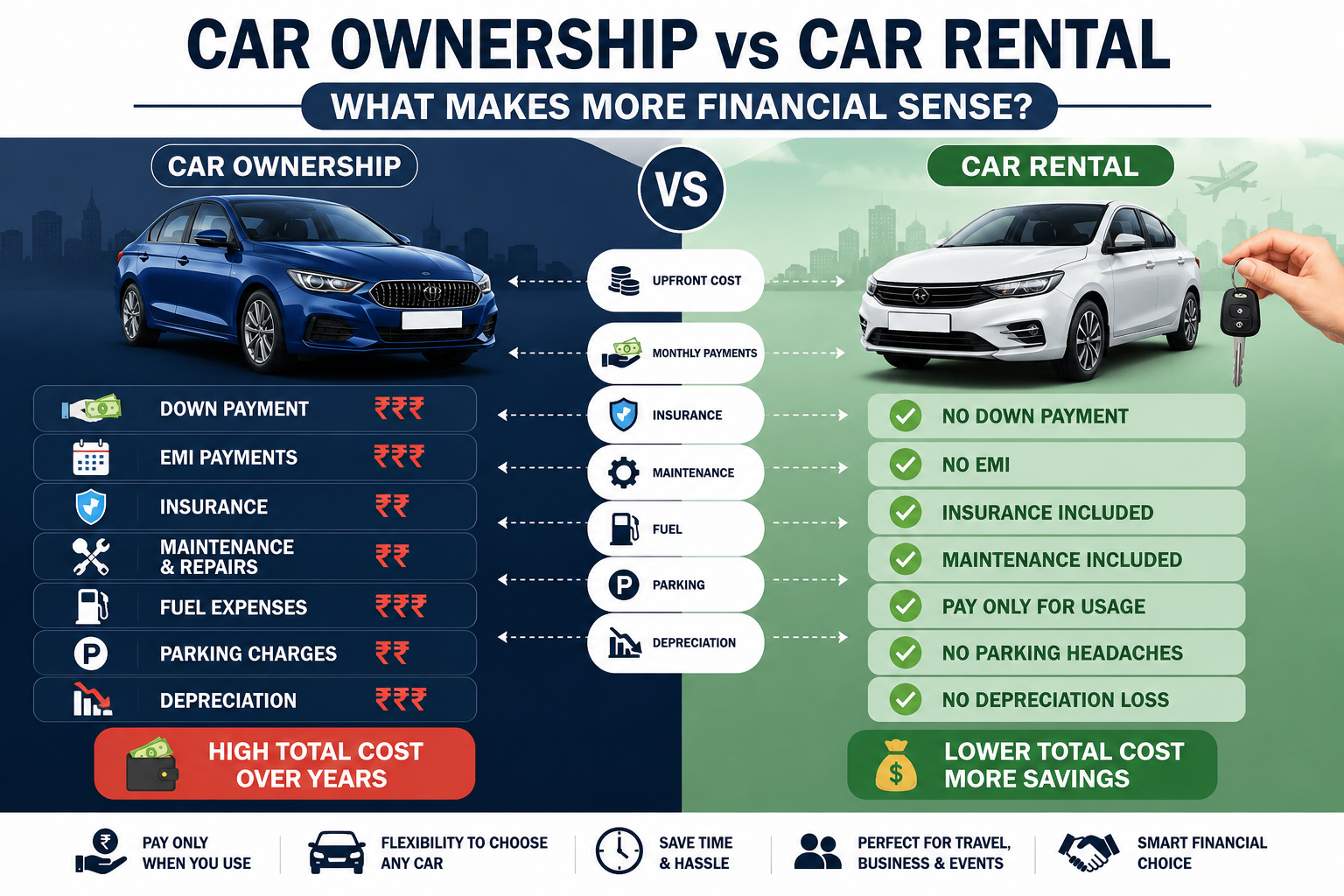
However, most people focus only on the car’s showroom price while ignoring the long-term expenses that come with ownership. Down payments, EMIs, insurance, maintenance, fuel costs, parking charges, and vehicle depreciation can significantly increase the actual cost of owning a car over time.
On the other hand, car rental services have become more affordable and accessible across India. Instead of investing lakhs in a vehicle purchase, many individuals and businesses now prefer renting a car whenever required. This eliminates several ownership-related expenses while providing flexibility and convenience.
So, when comparing car ownership vs. car rental, which option offers better financial value? In this guide, we’ll break down the real costs of both options using practical examples and calculations to help you make a smarter financial decision.
This raises an important question:
Car Ownership vs Car Rental – Which option makes more financial sense?
Let’s compare both options using real numbers.
Imagine you are planning to buy a car worth ₹15 lakh.
At first glance, you may think:
However, the reality is very different. The showroom price is only the beginning. Once you include financing, insurance, maintenance, fuel, and other recurring expenses, the actual ownership cost becomes significantly higher.
Let’s break down every major expense one by one.
Most car buyers finance their vehicle through a loan. Assuming a 20% down payment, the initial cost looks like this:
| Item | Amount |
|---|---|
| Car Price | ₹1,500,000 |
| Down Payment (20%) | ₹300,000 |
| Loan Amount | ₹1,200,000 |
Before driving the car home, you already spent ₹3 lakh from your savings. This is money that could otherwise be invested or used for other financial goals.
Now comes the loan repayment, which becomes a fixed monthly commitment for several years.
| Loan Details | Value |
|---|---|
| Loan Amount | ₹1,200,000 |
| Loan Tenure | 5 Years |
| Average Interest Rate | 9% |
| Monthly EMI | ₹25,000 |
Monthly EMI: ₹25,000
Annual EMI Cost: ₹300,000
Total EMI Over 5 Years: ₹1,500,000
For five years, a fixed portion of your income remains committed to your vehicle.
Insurance is mandatory for every vehicle owner in India. Depending on the vehicle and coverage type, annual insurance costs can range from ₹25,000 to ₹50,000.
Let’s use a realistic estimate:
Annual Insurance Cost: ₹35,000
Five-Year Cost: ₹35,000 × 5 = ₹175,000
Many buyers forget to include insurance when calculating the true cost of car ownership.
Every vehicle requires regular maintenance throughout its life cycle.
Common maintenance expenses include:
Even if your vehicle performs perfectly, routine maintenance is unavoidable.
Average Annual Maintenance Cost: ₹35,000
Five-Year Cost: ₹35,000 × 5 = ₹175,000
For premium and luxury vehicles, maintenance costs can be significantly higher.
Fuel is one of the largest recurring expenses of car ownership and increases directly with vehicle usage.
| Fuel Calculation | Value |
|---|---|
| Annual Driving Distance | 15,000 KM |
| Average Fuel Cost | ₹7 Per KM |
| Annual Fuel Expense | ₹105,000 |
| Five-Year Fuel Expense | ₹525,000 |
The more you drive, the higher your fuel expenses become. For frequent travelers, fuel can easily become one of the biggest ownership costs.
Parking costs are often ignored during the vehicle buying decision. However, many car owners regularly spend money on parking throughout the year.
Common parking expenses include:
Let’s use a realistic estimate:
Parking Cost Per Month: ₹2,000
Annual Parking Cost: ₹24,000
Five-Year Parking Cost: ₹120,000
In metropolitan cities such as Delhi, Mumbai, Bengaluru, and Hyderabad, parking expenses can be significantly higher depending on location and vehicle usage.
Vehicle depreciation is often considered the biggest hidden cost of car ownership.
The moment a new vehicle leaves the showroom, it begins losing value. Even with excellent maintenance and careful driving, depreciation is unavoidable.
Original Car Value: ₹1,500,000
Estimated Value After 5 Years: ₹8–9 Lakh
Estimated Value Lost: ₹6–7 Lakh
Assumed Depreciation Loss: ₹650,000
This financial loss occurs regardless of how carefully you maintain the vehicle and should always be included when calculating total ownership costs.
Now let’s calculate the actual cost of ownership over a five-year period.
| Expense | Cost Over 5 Years |
|---|---|
| Down Payment | ₹300,000 |
| EMI Payments | ₹1,500,000 |
| Insurance | ₹175,000 |
| Maintenance & Servicing | ₹175,000 |
| Fuel Expenses | ₹525,000 |
| Parking Charges | ₹120,000 |
| Depreciation Loss | ₹650,000 |
| Grand Total | ₹3,445,000 |
A car with a showroom price of ₹15 lakh can actually cost more than ₹34.45 lakh over five years when all ownership expenses are considered.
Most buyers focus only on the purchase price, but the true cost includes financing, insurance, maintenance, fuel, parking charges, and vehicle depreciation.
That is why financial experts recommend evaluating the Total Cost of Ownership (TCO) rather than looking only at the showroom price.
Now let’s look at the alternative.
With a professional car rental service, most ownership-related expenses disappear.
You don’t have to worry about:
Instead, you simply pay for transportation when you need it.
Whether it is an airport transfer, business trip, family vacation, wedding event, or weekend getaway, the financial commitment remains limited to the actual usage period.
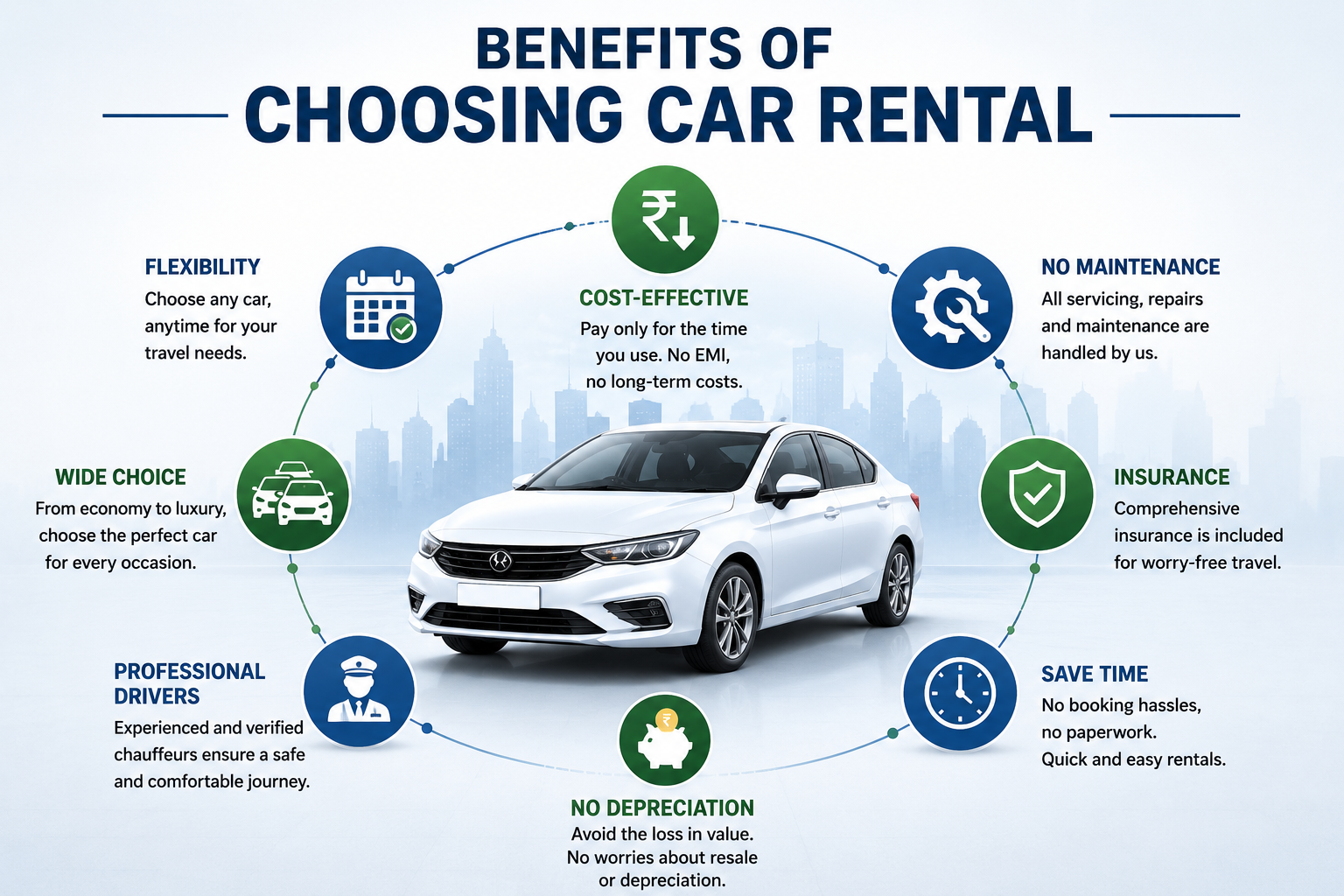
Car rental services offer several advantages beyond cost savings, making them a practical choice for both business and leisure travelers.
You are not restricted to a single vehicle.
There is no loan, EMI, or large upfront investment. This helps maintain better cash flow and greater financial flexibility.
Vehicle servicing, repairs, insurance management, and maintenance responsibilities are handled by the rental company.
Many travelers enjoy premium and luxury vehicles whenever required without spending lakhs on vehicle ownership.
Many rental providers offer experienced chauffeurs, eliminating the stress of driving, navigation, parking, and route planning.
Car rental is often the better choice if:
For many urban professionals, renting can be significantly more cost-effective than buying.
Companies looking to reduce transportation costs frequently choose a corporate car rental service instead of maintaining their own fleet of vehicles.
Owning a vehicle may still be the right decision if:
In these situations, ownership may justify the associated expenses.
| Factor | Car Ownership | Car Rental |
|---|---|---|
| Down Payment | Required | Not Required |
| EMI | Monthly Expense | No EMI |
| Insurance | Owner Pays | Included by Provider |
| Maintenance | Owner Pays | Included by Provider |
| Depreciation | Major Cost | No Depreciation Loss |
| Parking Charges | Owner Pays | Usually Not Applicable |
| Vehicle Choice | Limited to One Vehicle | Multiple Options Available |
| Financial Commitment | High | Low |
| Flexibility | Limited | High |
The answer to the Car Ownership vs Car Rental debate depends on how frequently you use a vehicle.
If you drive every day and need constant access to a car, ownership may still be worth considering.
However, when you account for down payments, EMIs, insurance, maintenance, fuel, parking, and depreciation, the real cost of owning a car can be surprisingly high.
For occasional travelers, business professionals, families, and individuals seeking flexibility, car rental services often provide a more practical and financially efficient solution.
Before purchasing your next vehicle, calculate the total ownership cost—not just the showroom price. The numbers may completely change your decision.
For airport transfers, business travel, family vacations, and special occasions, renting often proves to be the smarter financial choice. Many travelers prefer an airport transfer service to avoid parking expenses and vehicle maintenance responsibilities.
The growth of domestic travel and business mobility in India has also increased the demand for flexible transportation solutions, as highlighted by the Ministry of Tourism, Government of India.
For occasional users and travelers, renting is often more affordable because there are no EMIs, maintenance costs, insurance payments, or depreciation losses.
Depreciation is generally the biggest hidden cost, as vehicles lose a significant portion of their value over time regardless of how carefully they are maintained.
Most professional car rental providers include maintenance, servicing, and insurance within their service costs, reducing financial responsibilities for customers.
Car rental is ideal for travelers, business professionals, tourists, families, and individuals who do not require a vehicle on a daily basis.
Buying a car can be beneficial for daily users and frequent commuters, but the decision should be based on the total cost of ownership rather than the purchase price alone.