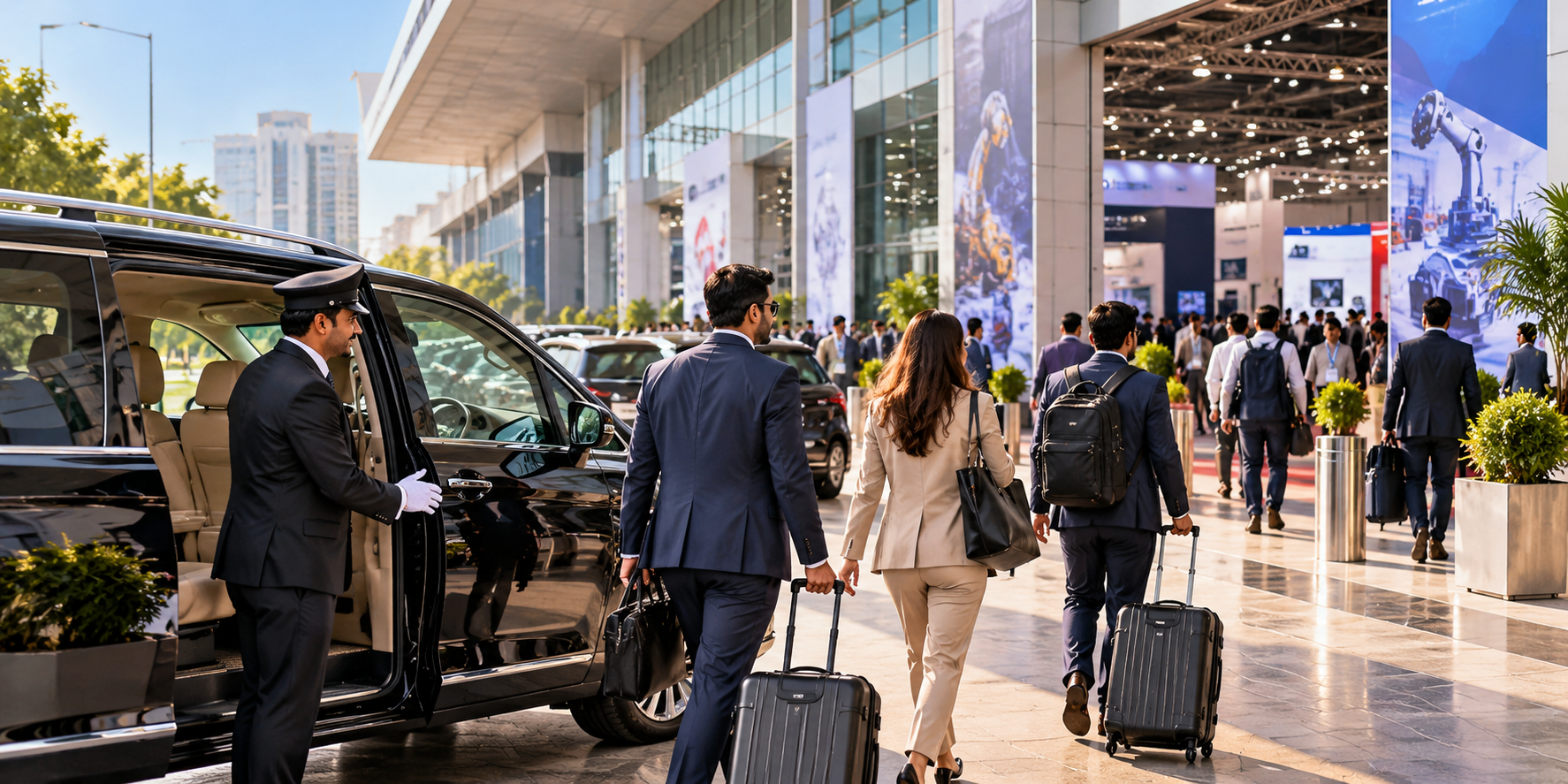
How Corporate Mobility Solutions Support Multi-City Businesses
Introduction
Corporate mobility solutions are becoming an essential part of modern business operations as organizations expand across multiple cities. A company headquartered in Bangalore may operate offices in Hyderabad, Gurgaon, Pune, and Chennai, making employee transportation, executive travel, airport transfers, and business mobility increasingly complex. Managing these requirements through multiple vendors and fragmented systems often creates inefficiencies, making corporate mobility a strategic business function rather than just a transportation service.
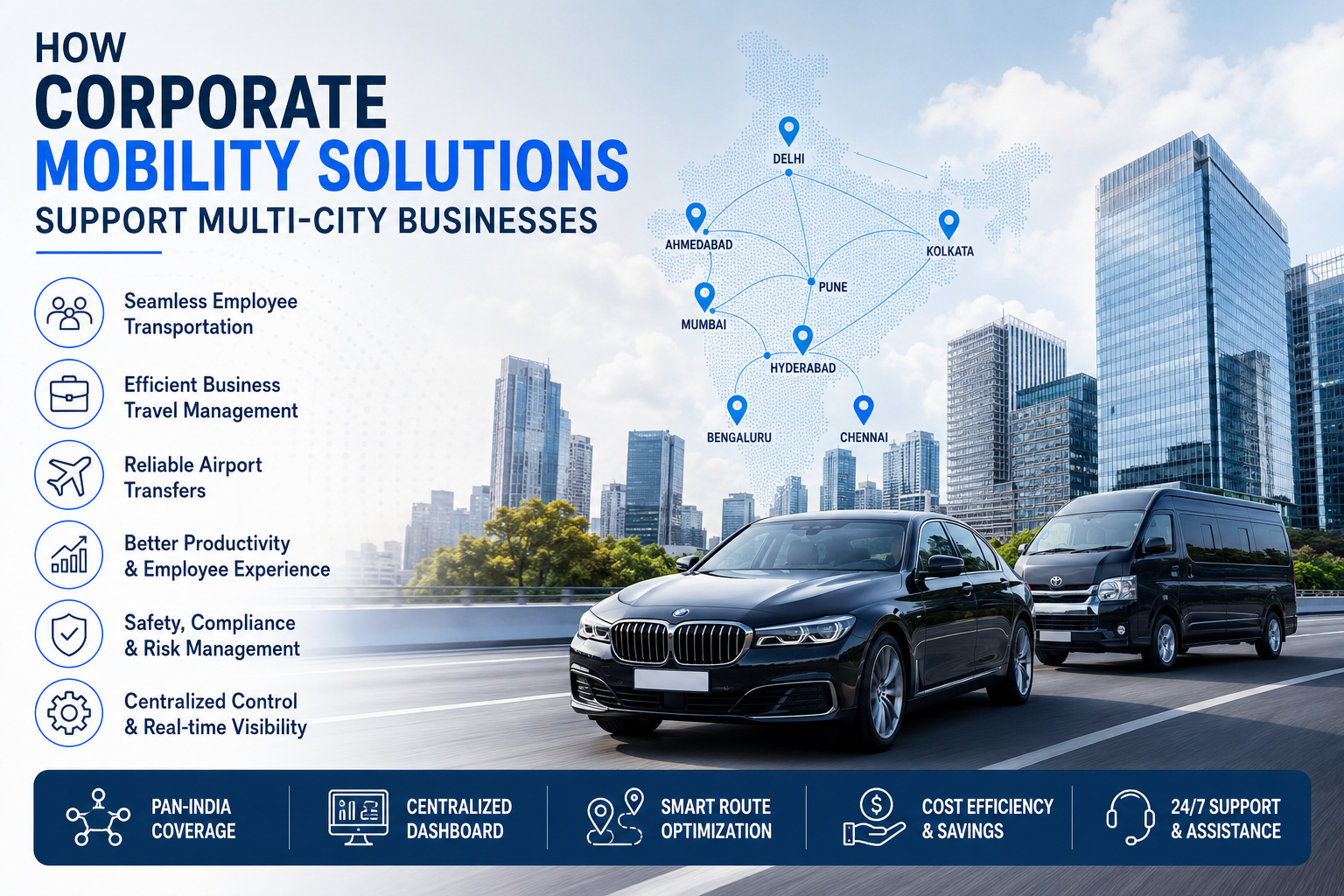
Why Multi-City Businesses Face Unique Transportation Challenges
Managing transportation within a single city is relatively straightforward.
Managing transportation across five, ten, or twenty cities is a completely different challenge.
Every city operates differently. Traffic conditions in Bangalore differ significantly from those in Hyderabad. Airport transfer requirements in Mumbai are very different from those in Chennai. Employee commuting patterns in Gurgaon may not resemble those in Pune or Ahmedabad.
As businesses expand geographically, transportation teams often encounter operational complexities that become increasingly difficult to manage using traditional local vendor models.
📍 Multiple Local Vendors
💰 Different Pricing Structures
⭐ Inconsistent Service Quality
📋 Varying Compliance Requirements
👁️ Lack of Centralized Visibility
📊 Separate Reporting Systems
🛡️ Different Safety Standards
Over time, these challenges increase operational complexity, administrative workload, and costs for businesses operating across multiple locations.
Without a unified transportation strategy, businesses often find themselves spending more time managing transportation than improving it.
The Rise of Corporate Mobility Solutions in India
India’s business landscape has changed significantly over the last decade.
The rise of global capability centers, IT parks, manufacturing clusters, startup ecosystems, and regional delivery centers has increased workforce movement across the country.
Employees now travel more frequently between offices, project locations, airports, customer sites, and business events than ever before.
This growth has accelerated demand for scalable corporate mobility solutions that can support business operations across multiple locations while maintaining consistency and control.
Organizations increasingly require transportation systems capable of operating seamlessly across cities while adapting to local operational requirements.
Why Consistency Matters Across Multiple Locations
One of the biggest challenges for growing organizations is maintaining consistency across different locations.
An employee travelling in Bangalore expects the same experience while visiting Hyderabad.
An executive travelling to Mumbai expects similar service standards when attending meetings in Gurgaon.
Clients visiting regional offices expect professional transportation regardless of location.
Maintaining this consistency becomes increasingly difficult when businesses rely on independent local vendors in every city, each operating with different vehicles, processes, and service standards.
Modern corporate mobility solutions help organizations create a single transportation standard across all locations.
🚘 Vehicle Quality Standards
🛡 Driver Verification Procedures
📋 Safety Policies
📱 Booking Processes
🎧 Customer Support
📊 Reporting Structures
💳 Billing Systems
This creates a uniform transportation experience across all operational locations, improves employee satisfaction, and significantly reduces administrative complexity for transportation teams.
Supporting Employee Transportation Across Multiple Cities
Employee transportation is often one of the most complex aspects of corporate mobility.
Office timings vary between locations.
Shift operations differ from city to city.
Employee density changes significantly across offices.
Traffic conditions can alter pickup schedules and route planning requirements.
Managing these variables independently at each location often creates inefficiencies and inconsistent employee experiences.
Centralized corporate mobility solutions simplify this process by providing a unified transportation framework capable of supporting multiple cities simultaneously.
Employees benefit from predictable transportation standards while businesses gain improved visibility and operational control.
Many organizations also combine mobility programs with dedicated office cab services to support daily employee commuting requirements across major cities.
Businesses investing in transportation programs increasingly align their mobility practices with recommendations from the official Ministry of Road Transport and Highways.
Corporate Mobility Solutions Improve Employee Experience
Employee experience begins long before employees enter the office.
The quality of daily commuting directly influences stress levels, punctuality, productivity, and overall job satisfaction.
Employees travelling frequently between offices or customer locations expect transportation systems that are reliable and professional.
Long wait times, inconsistent vehicles, and unpredictable service quality can negatively impact morale and employee perception of the organization.
Modern mobility programs improve employee experience by providing the following:
- Reliable transportation.
- Consistent service quality.
- Better communication.
- Real-time updates.
- Improved safety measures.
These improvements contribute directly to workforce satisfaction and retention.
Simplifying Executive and Business Travel
Senior leadership teams often travel more frequently than other employees.
Client meetings, conferences, project reviews, airport transfers, and site visits require transportation that is efficient, professional, and dependable.
Managing executive transportation through multiple local vendors often creates unnecessary complexity.
Different service standards, communication challenges, and inconsistent vehicle quality can affect business travel experiences.
Corporate mobility programs simplify executive travel by offering centralized booking systems and standardized service delivery across cities.
This allows leadership teams to focus on business priorities rather than transportation logistics.
Centralized mobility programs frequently include corporate car rental services and premium transportation options for leadership teams and visiting clients.
Why Airport Transfers Become More Complex for Multi-City Businesses
Airport transportation is often one of the most overlooked challenges for growing organizations.
Executives arrive at unfamiliar airports.
Clients require reliable pickups.
Project teams travel continuously between locations.
Flight schedules change frequently.
Managing airport transfers separately in every city creates operational inefficiencies and increases administrative effort.
Centralized corporate mobility solutions help organizations standardize airport transfer processes while improving reliability and customer experience.
For companies operating nationally, this creates significant operational advantages.
Businesses with frequent intercity travel requirements often standardize their airport transfer services across all operational locations.
Technology Is Driving Modern Corporate Mobility Solutions
Technology has completely transformed transportation management over the past decade.
Businesses today expect real-time visibility into transportation operations, employee movement, and service performance across multiple locations.
Traditional transportation models often relied on manual coordination, phone calls, spreadsheets, and fragmented vendor communication.
Modern corporate mobility platforms operate very differently by providing centralized control and instant access to operational information.
Modern mobility platforms provide transportation teams with powerful digital tools that improve visibility, efficiency, and decision-making.
📍 GPS Tracking
🚗 Real-Time Trip Monitoring
🔔 Automated Notifications
🛣 Route Optimization
📱 Digital Booking Systems
📞 Driver Communication Tools
📊 Centralized Dashboards
📈 Utilization Reports
💰 Cost Analytics
These capabilities provide transportation teams with significantly greater visibility, operational control, and decision-making ability compared to traditional vendor management models.
As businesses continue expanding across multiple cities, technology-driven mobility solutions are increasingly becoming a competitive advantage rather than simply an operational convenience.
Route Optimization Improves Efficiency Across Cities
Traffic congestion remains one of the largest productivity challenges facing businesses operating in major Indian cities.
Routes that require thirty minutes in one city may take ninety minutes in another.
Weather conditions, public events, infrastructure projects, and peak traffic periods create additional uncertainty.
Route optimization technology helps businesses improve transportation efficiency by:
- Reducing travel times.
- Improving vehicle utilization.
- Lowering operational costs.
- Increasing on-time arrivals.
- Reducing employee waiting times.
For businesses operating across multiple cities, these improvements generate measurable productivity gains.
Corporate Mobility Solutions Improve Cost Visibility
Transportation spending often becomes difficult to monitor once businesses expand into multiple locations.
Different offices may book transportation independently, creating fragmented reporting and inconsistent pricing structures.
This lack of visibility often leads to higher operational costs and weaker financial control.
Centralized mobility programs improve financial management by enabling organizations to:
💼 Consolidate transportation expenses
📊 Monitor utilization patterns
🎯 Improve budgeting accuracy
🔍 Identify inefficiencies
🤝 Negotiate better contracts
For finance and procurement teams, improved cost visibility is often one of the strongest reasons for investing in centralized transportation management.
Why Vendor Management Becomes Difficult at Scale
Managing a single transportation partner is relatively easy.
Managing twenty vendors across multiple cities is not.
Procurement teams often struggle with:
- Multiple contracts.
- Separate invoices.
- Different support channels.
- Inconsistent reporting.
- Service quality monitoring.
Corporate mobility programs simplify vendor management by creating a single operational framework across all locations.
This reduces administrative complexity while improving accountability and reporting accuracy.
Supporting Business Continuity During Disruptions
Unexpected disruptions can affect transportation operations significantly.
Traffic congestion, severe weather conditions, public transport strikes, infrastructure work, and local events can all impact employee movement.
Organizations operating across multiple cities require transportation systems capable of responding quickly to changing conditions.
Modern corporate mobility solutions improve resilience through the following:
- Backup vehicles.
- Alternative routes.
- Centralized monitoring.
- Real-time communication.
- Flexible vendor allocation.
These capabilities help organizations maintain business continuity during operational disruptions.
Corporate Mobility Solutions Support Future Business Growth
Transportation requirements evolve alongside business growth.
Organizations opening new offices require mobility systems capable of scaling quickly without creating operational bottlenecks.
This scalability is one of the biggest advantages of centralized mobility programs.
Rather than building transportation operations from scratch in every city, businesses can extend existing systems into new markets while maintaining consistency and operational control.
For rapidly growing organizations, this flexibility becomes a major competitive advantage.
Why Corporate Mobility Is Becoming a Strategic Business Function
Transportation was once viewed primarily as an administrative responsibility handled by operations or facility teams.
Today, that perspective is changing rapidly.
As organizations expand across multiple cities and employee expectations continue evolving, mobility now directly influences several core business outcomes.
🚀 Employee Productivity
😊 Workforce Satisfaction
🤝 Customer Experience
🛡 Business Continuity
🏢 Employer Branding
⚙ Operational Efficiency
As businesses continue expanding across India, mobility is increasingly becoming part of long-term business strategy rather than simply an operational requirement.
Organizations that invest in scalable transportation systems are often better positioned to support growth while maintaining employee experience, service quality, and operational consistency across multiple locations.
The companies that treat mobility as a strategic advantage today are likely to be the organizations that scale more efficiently tomorrow.
Conclusion
Business mobility has evolved far beyond traditional transportation management.
For organizations operating across multiple cities, mobility now plays a critical role in employee experience, executive travel, operational resilience, and business growth.
Modern corporate mobility solutions provide the consistency, visibility, and scalability required to support geographically distributed workforces and rapidly expanding operations.
As India’s business landscape continues becoming more interconnected, transportation will increasingly become a strategic business capability rather than simply a support function.
For multi-city businesses, investing in the right mobility strategy is no longer optional.
It is becoming essential for sustainable growth.
Frequently Asked Questions (FAQs)
What are corporate mobility solutions?
Corporate mobility solutions are transportation programs designed to manage employee travel, executive movement, airport transfers, and business transportation requirements across multiple locations.
Why are corporate mobility solutions important for multi-city businesses?
They help businesses improve consistency, operational efficiency, employee experience, and transportation visibility across different cities while reducing administrative complexity.
Do corporate mobility solutions include employee transportation?
Yes. Most mobility programs include employee transportation, office cab services, airport transfers, shift movement management, and executive travel solutions.
Can Corporate Mobility Solutions support pan-India operations?
Yes. Many organizations use centralized mobility programs to support operations across multiple cities and states while maintaining consistent service standards.
How do corporate mobility solutions improve employee experience?
They provide consistent service standards, improved safety, better reliability, and a more seamless transportation experience regardless of employee location.
Are technology platforms important for corporate mobility solutions?
Yes. GPS tracking, route optimization, digital bookings, utilization analytics, automated notifications, and centralized reporting are now essential components of modern mobility programs.
Modern corporate mobility solutions combine transportation expertise with technology to deliver safer, smarter, and more scalable mobility experiences for growing businesses.