When One Office Has Five Pickup Locations: Managing Multi-Location Employee Transport
Imagine managing transportation for an office in Gurugram where employees travel daily from Delhi, Noida, Faridabad, Ghaziabad, and different parts of Gurugram. Everyone needs to reach the same workplace, but their pickup locations, reporting times, and commuting distances are different. For HR managers and corporate administrators, this creates a complicated daily responsibility. Multi-location employee transport is designed to address such challenges by organizing employee pickups from different locations through planned routes, suitable vehicles, and coordinated schedules.
Instead of managing separate cab bookings for every employee or location, businesses can develop a structured transportation system that balances punctuality, employee convenience, and operating costs.
But how can a company manage five or more pickup locations without creating unnecessary delays?
Let’s explore the practical strategies that make multi-location employee transportation more efficient.
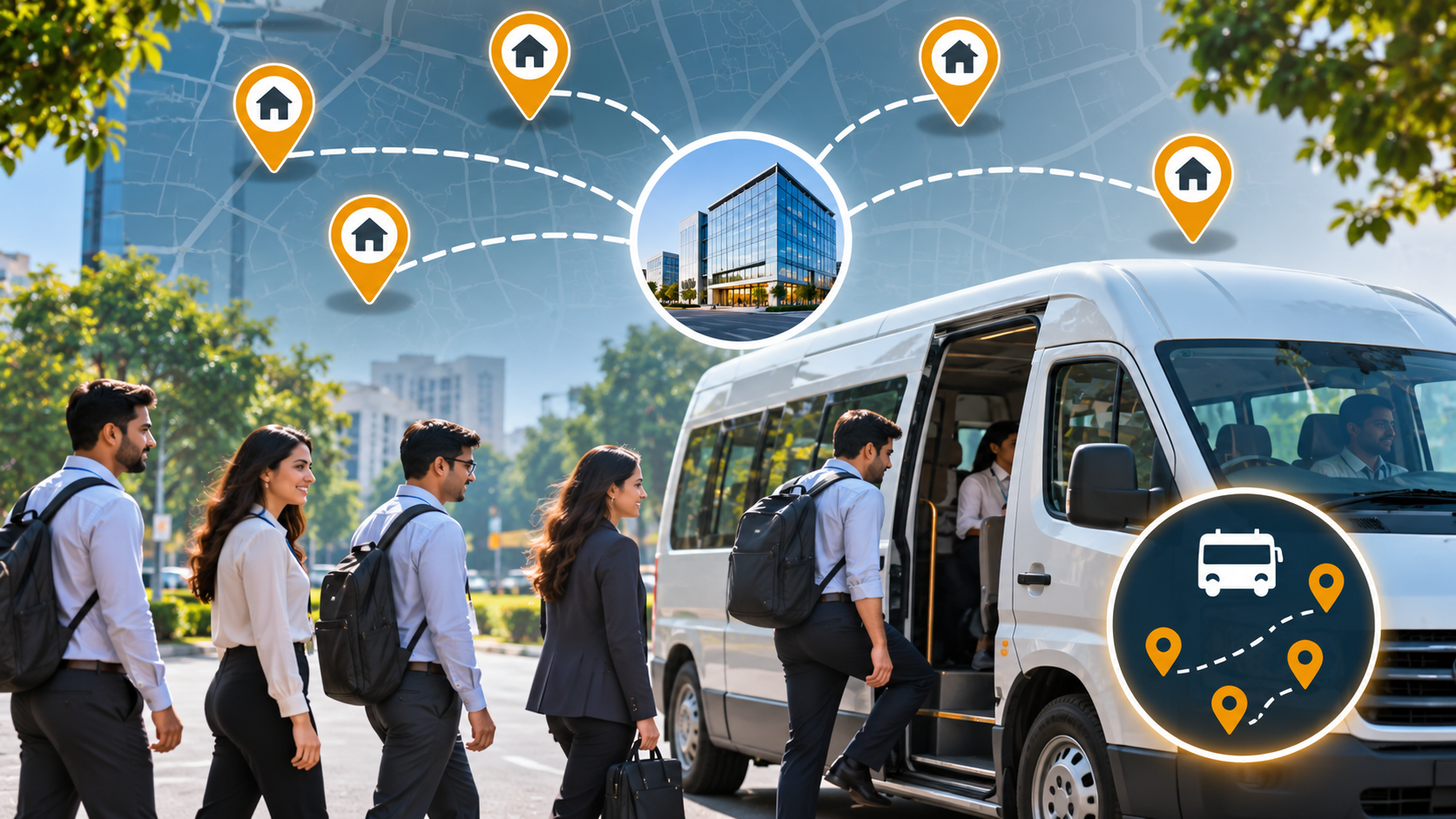
What Is Multi-Location Employee Transport?
Multi-location employee transport refers to a coordinated transportation arrangement in which employees are picked up from several residential areas or designated points and transported to one or more office locations.
Unlike a conventional office shuttle operating between two fixed points, this model involves multiple pickup locations, different passenger groups, and sometimes changing shift schedules.
For example, a company based in Gurugram might have employees travelling from:
Raj Nagar Extension, Ghaziabad
All five groups may need to reach the office before 9 AM.
Managing these journeys individually can create additional administrative work. However, a planned employee transportation system can help businesses coordinate vehicle allocation, departure times, and routes.
The objective is not simply to transport employees. It is to make daily commuting more organized and predictable.
Why Multi-Location Employee Transport Is Challenging
Managing one pickup point is relatively straightforward. Managing five or more requires careful coordination.
Different Travel Distances
An employee living near the office may need only a short commute, while another travelling from Ghaziabad could spend considerably longer on the road.
Using the same pickup schedule for every location would be impractical.
Unpredictable Traffic
Delhi NCR experiences varying traffic conditions across major routes and business corridors.
Congestion around office hours can affect travel times, particularly on routes connecting Delhi, Noida, and Gurugram.
Changing Employee Attendance
Employees may work from home, take leave, change shifts, or report to different office locations.
These changes influence passenger demand and vehicle requirements.
Multiple Vehicles and Chauffeurs
When different vehicles serve different areas, the transport team needs visibility into assignments, reporting times, and trip completion.
Without clear coordination, even a small schedule change can create confusion.
1. Start With Employee Location Mapping
The first step in managing multi-location employee transport is understanding where employees are travelling from.
HR or facility teams should collect the information needed to create a practical transport plan.
This may include residential areas, preferred pickup points, reporting times, and shift details.
Create Pickup Clusters
Instead of treating every employee address as an independent destination, group nearby employees into geographic clusters.
For example, employees living in Dwarka and nearby sectors may be assigned to a common route if travel conditions and pickup timings make that arrangement practical.
Similarly, employees in neighboring Gurugram sectors may be served through another route.
Identify Suitable Pickup Points
A pickup point should be reasonably accessible and appropriate for the time of travel.
Businesses should consider road access, stopping restrictions, lighting, and employee safety when selecting locations.
Protect Employee Information
Residential addresses and commuting details are personal information.
Companies should collect only necessary details, restrict access to authorized personnel, and follow applicable privacy requirements.
Good location mapping creates the foundation for efficient route planning.
2. Design Routes Around Actual Travel Patterns
Route optimization is one of the most important parts of employee pickup and drop services.
A shorter route on a map is not always the fastest route during office hours.
Traffic conditions, pickup stops, road restrictions, and passenger boarding times can influence the journey.
Avoid Unnecessary Detours
Combining employees from distant areas into one vehicle may appear cost-effective, but it can create long and uncomfortable journeys.
For example, combining pickups from Faridabad and Ghaziabad in a single route to Gurugram would generally require careful justification.
Separate routes may provide a more practical solution.
Consider Reporting Deadlines
If employees must report by 9 AM, transportation schedules should include a reasonable buffer for expected traffic and boarding time.
However, excessive buffers can force employees to leave home unnecessarily early.
Review Route Performance
Transport teams should periodically review travel duration, recurring delays, and employee feedback.
This helps identify routes that need adjustment.
The goal is to balance vehicle utilization with employee commuting convenience.
3. Select the Right Vehicles for Different Pickup Locations
Not every route requires the same type of vehicle.
A route carrying four employees has different requirements from one transporting fifteen employees.
Businesses should select vehicles according to passenger demand, route conditions, and the transportation arrangement.
Match Capacity With Passenger Count
Using a large vehicle for a small passenger group may increase operating costs.
Conversely, assigning an undersized vehicle can create capacity problems.
Consider Journey Duration
Employees travelling longer distances may have different comfort requirements from those commuting a few kilometres.
Vehicle suitability should account for seating capacity, travel time, and passenger needs.
Plan for Attendance Changes
Passenger numbers can vary throughout the week.
A transportation provider and corporate administration team should agree on how vehicle allocation can be adjusted when demand changes.
For companies with recurring requirements, choosing the right vehicle mix can help improve transportation efficiency.
4. Coordinate Different Office Shifts
Many businesses operate beyond conventional office hours.
IT companies, BPOs, customer support centers, and other organizations may have morning, evening, and night shifts.
When employees travel from multiple locations, shift scheduling becomes an additional challenge.
Consider this illustrative example:
| Shift |
Reporting time |
Transport planning priority |
| Morning |
7 AM |
Early pickups and realistic travel buffers |
| General |
9 AM |
Peak-hour traffic management |
| Evening |
2 PM |
Afternoon pickup coordination |
| Night |
10 PM |
Night-travel procedures and safety |
Use Confirmed Employee Rosters
HR teams should share shift schedules with the transport coordinator before each planning cycle.
This helps determine how many vehicles are needed and which locations must be covered.
Manage Shift Changes
Employees may exchange shifts or extend working hours.
A defined process for requesting and approving transport changes reduces confusion.
Avoid Long Waiting Periods.
Transport departure times should align with actual shift-end times wherever practical.
Employees should not routinely face excessive waiting periods because routes were designed around outdated schedules.
5. Make Employee Safety a Priority
Safety should be a central consideration in every employee transportation program, particularly for early-morning and late-night journeys.
When employees travel from several locations, organizations need clear procedures for pickup verification and trip coordination.
Important measures to consider include:
- Chauffeur identity and verification procedures
- Vehicle maintenance and applicable permits
- Approved pickup and drop-off points
- Trip information shared with employees
- Emergency communication channels
- Procedures for missed pickups
- Night-shift safety requirements
Employers should also review any applicable state-specific requirements for transporting women employees during night shifts.
A transport plan should never prioritize route efficiency at the expense of essential safety requirements.
6. Control Employee Transportation Costs
Multi-location transportation can become expensive when vehicles are allocated without considering actual passenger demand.
However, cost control should focus on efficient planning rather than simply reducing the number of vehicles.
Reduce Empty Kilometers
A vehicle travelling long distances without passengers can increase transportation expenses.
Careful route allocation may reduce unnecessary empty movement.
Monitor Vehicle Utilization
Review how many passengers regularly use each route.
If demand changes significantly, the vehicle arrangement may need to be reconsidered.
Compare Transportation Models
Businesses may evaluate dedicated vehicles, scheduled shuttle arrangements, or managed employee transportation contracts.
The right model depends on workforce size, pickup distribution, shift requirements, and service expectations.
Understand Contract Charges
Before finalizing an agreement, clarify applicable kilometre limits, additional hours, night allowances, tolls, and other charges.
Transparent cost planning helps organisations manage transportation budgets more effectively.
7. Improve Communication Between Employees and Transport Teams
Even a well-designed route can experience delays or last-minute changes.
Clear communication helps prevent these situations from becoming larger operational problems.
Employees should know their assigned pickup location, expected pickup time and whom to contact if an issue occurs.
HR and facility managers should also have a defined process for communicating roster changes to the transportation provider.
Create One Communication Channel
Avoid situations where employees receive conflicting information from multiple departments.
A central transport coordination process helps maintain consistency.
Notify Employees of Changes
If a pickup location or schedule changes, affected employees should receive the updated information promptly.
Collect Employee Feedback
Recurring complaints about late pickups, long routes or unsuitable pickup points may indicate that the transport plan needs improvement.
Regular feedback can help companies identify issues that are not immediately visible through scheduling records.
8. Track the Right Transportation Performance Metrics
A successful multi-location employee transport programme should be measured using practical performance indicators.
These may include:
| Performance metric |
What it helps evaluate |
| On-time pickup rate |
Schedule reliability |
| On-time office arrival |
Commute planning effectiveness |
| Average employee travel time |
Route convenience |
| Vehicle occupancy |
Capacity utilisation |
| Missed pickup incidents |
Operational coordination |
| Transport cost per trip |
Budget efficiency |
| Employee complaints |
Service improvement opportunities |
Reviewing these metrics can help HR teams make informed decisions.
For example, if one route consistently arrives late despite departing earlier, the issue may be related to its design rather than chauffeur performance.
Similarly, low vehicle occupancy may suggest that passenger allocation should be reviewed.
The purpose of monitoring is continuous improvement, not simply collecting more reports.
9. How Indian Travel House Can Support Multi-Location Employee Transport
Managing employee transportation across several pickup locations requires coordination between company administrators, employees and the transportation provider.
Indian Travel House offers chauffeur-driven transportation solutions for corporate travel and employee commuting requirements.
For businesses exploring employee pickup and drop services, the company can be contacted to discuss requirements such as:
Multiple pickup locations: Transportation arrangements based on employee residential clusters and designated pickup points.
Shift-based commuting: Planning around different reporting and departure schedules.
Vehicle requirements: Selecting suitable vehicle categories based on passenger demand.
Corporate transportation: Supporting business travel and recurring office transportation needs.
Long-term arrangements: Discussing transportation requirements that extend beyond occasional bookings.
The appropriate service model, monitoring arrangements, operating hours and contractual terms should be confirmed directly before booking.
For companies operating across Delhi NCR, structured transport planning can reduce the administrative burden of managing daily employee journeys.
Example: Managing Five Pickup Locations for One Gurugram Office
Consider a hypothetical company with 100 employees working at a Gurugram office.
The workforce travels from five main pickup clusters.
| Location |
Illustrative employee count |
| Dwarka |
25 |
| Noida |
20 |
| Ghaziabad |
15 |
| Faridabad |
20 |
| Gurugram |
20 |
Instead of allocating vehicles without considering passenger distribution, the company can begin by mapping each cluster and evaluating suitable routes.
The planning process might involve assigning separate routes to geographically distant areas, reviewing reporting times and matching vehicle capacity to confirmed demand.
It should also include procedures for attendance changes, missed pickups and night-shift requirements.
These numbers are illustrative, not a quotation or proposed fleet configuration.
The main lesson is that one office does not require one identical transportation solution for every employee.
Different pickup locations may need different routes, schedules and vehicle arrangements.
Frequently Asked Questions
1. What is multi-location employee transport?
Multi-location employee transport is a coordinated service that picks up employees from several locations and transports them to their workplace or designated office destinations.
2. How can companies manage five or more employee pickup points?
Companies can group nearby employees, plan suitable routes, coordinate shift schedules, allocate vehicles according to demand and maintain clear communication with their transport provider.
3. Can employee pickup routes change regularly?
Yes. Routes can be reviewed or adjusted when employee attendance, residential locations or shift requirements change, depending on the service agreement.
4. How can businesses reduce employee transportation costs?
Route optimisation, appropriate vehicle allocation, better passenger grouping and monitoring of empty kilometres may help reduce unnecessary expenses.
5. Is multi-location transportation suitable for night shifts?
Yes. However, night-shift arrangements require additional attention to employee safety, pickup locations, communication and applicable regulations.
6. Does Indian Travel House provide employee transportation services?
Indian Travel House offers corporate transportation and employee commuting solutions. Businesses can enquire about multi-location pickup requirements and available service arrangements.
Managing multi-location employee transport becomes increasingly important when employees travel to one workplace from several parts of a city or region.
Without structured planning, companies may face repeated delays, inefficient routes, unnecessary transportation costs and employee dissatisfaction.
By mapping employee locations, creating practical routes, selecting suitable vehicles and coordinating shift schedules, organisations can build a more organised commuting system.
For businesses in Delhi NCR, where employees often travel between Delhi, Gurugram, Noida, Ghaziabad and Faridabad, effective transportation planning can make a meaningful difference to daily operations.
Need employee pickup and drop services across multiple locations?
Visit Indian Travel House to explore corporate transportation solutions and discuss a suitable employee commuting arrangement for your organisation.