Car Rental for Film & Production Crews: Managing Multi-Location Travel
Car rental for film production becomes particularly important when actors, technicians, production teams, and equipment need to move between multiple shooting locations on a fixed schedule. Unlike ordinary business travel, a film shoot may begin before sunrise, continue late into the night, and involve several location changes in a single day.
Imagine a production team shooting an advertisement in Delhi NCR. The crew is staying in different hotels; some members are arriving at Delhi Airport; the first shoot is in Gurugram; another location is in South Delhi; and the next day’s schedule moves to Greater Noida.
Managing all these movements through last-minute transport bookings can quickly become complicated.
This is where planned film production transportation can help the production team keep vehicles, routes, and schedules coordinated throughout the shoot.
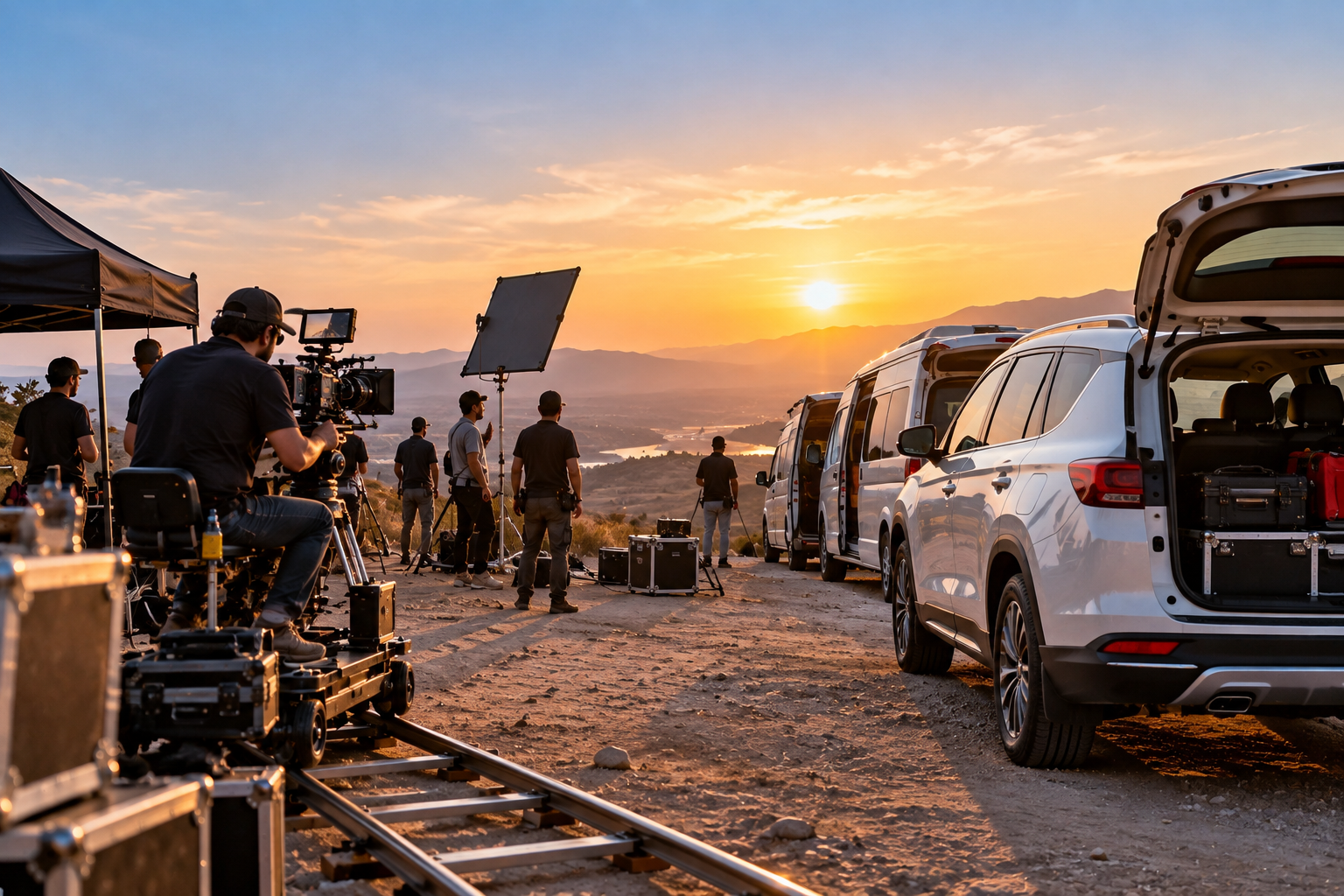
Why Film Production Transportation Is Different
Transportation for a film or video production is not simply about taking passengers from one point to another.
A production may involve directors, actors, camera teams, makeup artists, stylists, technicians, production assistants, and other crew members. Different people may need to reach the same location at different times.
The schedule can also change according to weather, lighting conditions, location availability, or production requirements.
This means transportation needs to be flexible enough to adapt to the production schedule rather than following a standard office routine.
Moving a Large Production Crew
Even a relatively small shoot can involve a significant number of people.
If everyone arranges transportation individually, the production coordinator may have to track multiple vehicles and arrival times. A delay involving a few important crew members can affect the day’s schedule.
With car rental for film crews, transportation can instead be planned according to groups and reporting times.
For example, vehicles can be assigned separately for:
- Actors and senior production members
- Camera and technical teams
- Makeup and styling teams
- Production coordinators
- Supporting crew
- Airport and hotel transfers
Depending on the size of the production, cars, SUVs, MUVs, vans, or larger vehicles can be planned according to passenger and luggage requirements.
Managing Multiple Shooting Locations
Multi-location shoots create another challenge.
A production may start at one location in the morning and move to another part of the city later in the day. In some cases, the next shooting location may even be in another city.
Consider a schedule such as:
Hotel → Shooting Location 1 → Location 2 → Outdoor Shoot → Hotel
If vehicles are booked separately for every journey, coordinating availability and pickup times can become difficult.
A dedicated vehicle arrangement allows the same transportation plan to move with the production.
It also gives the production coordinator a clearer picture of which vehicles are available and where different crew members need to be.
Early-Morning and Late-Night Shoots
Film schedules rarely follow conventional working hours.
A sunrise sequence may require the crew to leave the hotel at 4:00 AM. Night shoots can finish well after midnight.
Public transportation may not always suit these schedules, while arranging several last-minute rides at unusual hours can introduce unnecessary uncertainty.
Pre-planned film shoot transportation allows pickup times to be decided according to call sheets and reporting schedules.
Vehicles can be positioned for hotel pickups, shooting-location transfers, and return journeys based on the production plan.
Airport Transfers for Actors and Production Teams
Productions involving people arriving from other cities create another layer of transportation.
Actors, directors, clients, technicians, or specialists may arrive on different flights throughout the day.
Instead of the production team arranging each transfer independently, airport pickups can be incorporated into the overall transportation schedule.
For example:
Delhi Airport → Hotel → Shooting Location → Hotel
The same approach can be used when a production moves from one city to another.
For teams working across India, using organized
car rental services in India
can help coordinate airport transfers and local transportation without building a completely new transport arrangement for every destination.
What About Cameras, Props, and Production Equipment?
Passenger count is not the only consideration when selecting vehicles for a production.
Crew members may be travelling with camera cases, lighting equipment, costumes, makeup kits, props, and personal luggage.
Vehicle requirements should therefore be discussed before the shoot rather than simply booking according to the number of passengers.
For example, a vehicle that comfortably seats several passengers may have insufficient luggage space once production equipment is included.
Providing the transportation company with approximate passenger numbers, luggage requirements, and equipment details helps determine a more suitable vehicle mix.
Specialist or heavy production equipment may require dedicated logistics arrangements rather than ordinary passenger vehicles, so this should be planned separately where necessary.
Dedicated Vehicles for Actors and Key Personnel
Some productions may require dedicated vehicles for actors, directors, clients, or senior production personnel.
Their schedules can differ from those of the main crew.
An actor may need to travel between a hotel, makeup location, and shooting location, while the technical crew has already reached the set.
Assigning dedicated chauffeur-driven vehicles to key personnel can reduce the need to reorganize the entire crew transportation schedule whenever individual timings change.
Outstation Film Shoots
Production transportation becomes even more important when the shoot moves outside the city.
For example, a Delhi-based production could involve shooting locations in Agra, Jaipur, Neemrana, Rishikesh, or other nearby destinations.
Instead of treating each journey as an independent booking, the transportation can be planned as part of the complete production itinerary.
A possible schedule might look like:
Delhi → Jaipur → Shooting Locations → Hotel → Next Location → Delhi
For multi-day shoots, the production team should consider driver schedules, overnight stays, vehicle requirements, travel distances, and realistic journey times while preparing the itinerary.
This can help prevent an aggressive shooting schedule from becoming an impractical travel schedule.
Productions planning shoots across different Indian states can also refer to the India Cine Hub, the Government of India’s platform for information related to filming in India, permissions, and filming locations.
Why a Production Coordinator Needs a Clear Transport Plan
The production coordinator already has multiple responsibilities.
Transportation should not become a constant series of calls asking
“Where is the vehicle?”
“Has the actor been picked up?”
“Has the camera team arrived?”
“Which vehicle is going to the next location?”
A structured transport plan can include the vehicle requirement, passenger group, pickup point, reporting time, destination, and contact information.
Even when the shooting schedule changes, having a defined system makes adjustments easier than rebuilding transportation from scratch.
Choosing a Car Rental Company for Film Production
Before selecting a transportation partner for a film shoot, the production team should discuss its actual operational requirements.
Important points include:
Fleet options: Can different vehicle types be arranged according to crew size and luggage requirements?
Chauffeur-driven service: Are professional chauffeurs available for the required schedule and routes?
Multi-city capability: Can transportation continue if the production moves to another city?
Airport transfers: Can arriving and departing team members be incorporated into the transport plan?
Schedule flexibility: How will changes in reporting times or shooting locations be handled?
Operational coordination: Is there a clear point of contact for managing transportation requirements?
Price matters, but for a time-sensitive production, the ability to coordinate vehicles according to the shooting schedule can be equally important.
Planning Film Production Transportation With Indian Travel House
Indian Travel House provides chauffeur-driven transportation for business and professional travel requirements across India.
For film, television, advertising, and other production teams, transportation requirements can be planned according to the number of passengers, shooting locations, airport arrivals, and overall production itinerary.
Depending on the requirement, the transportation plan can include airport transfers, dedicated vehicles, crew movement, local transportation, and multi-city travel.
Production teams with shoots across different locations can discuss their itinerary in advance so that the vehicle requirement can be planned around the schedule rather than arranging individual journeys after the shoot begins.
Production houses, agencies, and corporate video teams can also use corporate car rental services when shoots require dedicated vehicles for executives, clients, production managers, or visiting teams.
A successful production depends on many moving parts, and transportation is literally one of them.
When actors, crew members, and production teams have different reporting times and several shooting locations to cover, relying entirely on last-minute transportation can make coordination unnecessarily difficult.
A planned car rental for film production arrangements gives production teams a structured way to manage hotel pickups, airport transfers, crew movement, and multi-location travel.
The objective is simple: transportation should support the shooting schedule—not become another production problem.